
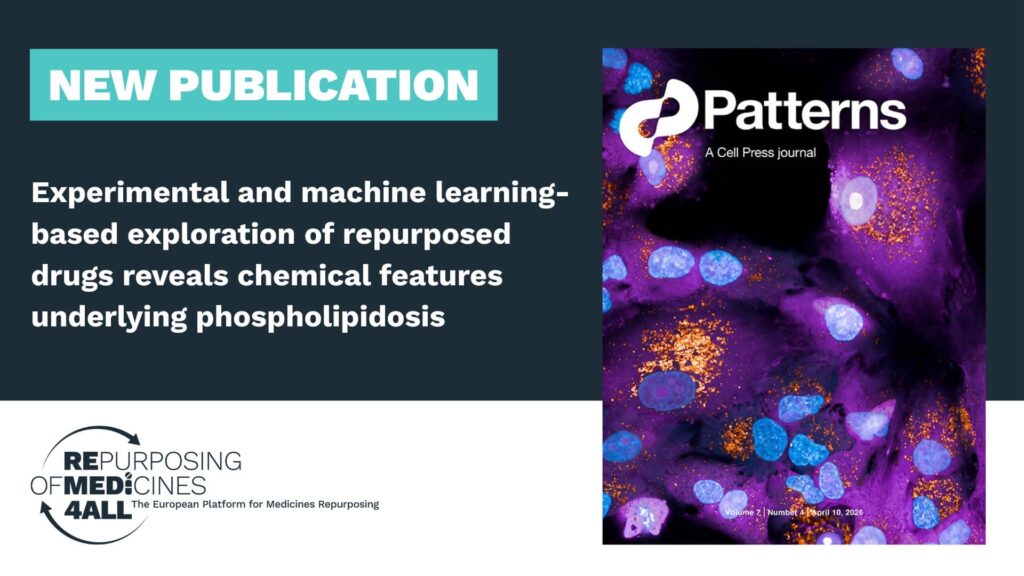
REMEDi4ALL Researchers have published a new study in Patterns analysing a comprehensive in-vitro dataset of >5000 repurposing compounds to develop an AI-based model which predicts the risk of phospholipidosis based on a drug’s chemical structure for earlier and more efficient detection of promising drug compounds for repurposing.
Phospholipidosis: a major confounding variable in drug discovery studies
Phospholipidosis (PLD) – excessive build-up of phospholipids inside cells – is a common and mostly harmless side effect of some medications and other stressors. However, in the lab, phospholipidosis can affect how cells respond in experiments and potentially mask the true results of drug screening, affecting downstream drug development work. It is important to better understand which drug compounds cause PLD to ensure only the most effective drugs remain within the drug development/repurposing pipeline.
REMEDi4ALL researchers investigated drug-induced PLD across different lab cell lines in a comprehensive collection of more than 5000 clinically used and repurposed small molecules. The research aimed to:
1. Identify if compounds which induced PLD had shared structural or physicochemical similarities.
2. Understand how these PLD-inducing compounds affect the results seen in early state drug screening.
3. Develop a robust, validated machine learning model to predict the risk of PLD based on a drug’s chemical structure for drug repurposing.
Creating an AI-based model for phospholipid detection
Researchers first put together a dataset of >5000 marketed and repurposed drugs from experiments (assays) assessing PLD in cells. The structure of these compounds alongside their physical and chemical properties were analysed and all of this information was used to train machine learning models. These models were rigorously evaluated and analysed to limit false-positives and ensure the robustness of the model and its applicability in the wider drug repurposing community.
Efficient confirmation of phospholipidosis in the context of drug repurposing
The team built models that accurately determined compounds which did and did not induce PLD in a range of different types of cells making this model applicable to the wider drug repurposing pipeline. While applying these models, authors also confirmed the activity of many antiviral drugs is due to PLD-associated mechanisms and not specific targeting of virus. Moreover, REMEDi4ALL researchers have publicly released the models, code and data to enable independent validation, reuse, and systematic screening of repurposed drugs for PLD.
A new method to help drive forward early drug repurposing studies
This work could represent a new way to more quickly and efficiently identify the difference between the true effects of drug candidates and effects associated with PLD for safer and more successful drug repurposing.
“By flagging PLD-prone molecules before costly mechanistic and in vivo studies, our models can substantially reduce PLD-driven false positives in phenotypic and antiviral screening cascades, as starkly illustrated during the SARS-CoV-2 repurposing efforts and now find application in new antiviral screens like hepatitis E (HEV).”
– Maria Kuzikov, First Author & Senior Scientist in Assay Development & Screening at the Fraunhofer Institute in Hamburg
Read the full publication here: https://doi.org/10.1016/j.patter.2025.101453 .
This research was published as part of the REMEDi4ALL initiative, a Horizon Europe-funded project creating a platform for patient-centric drug repurposing across Europe and beyond. REMEDi4ALL drives innovation across the entire drug repurposing pipeline, providing the infrastructure and standards needed to boost translational research and deliver more effective, safe therapies to patients, faster.
- Read the paper here.