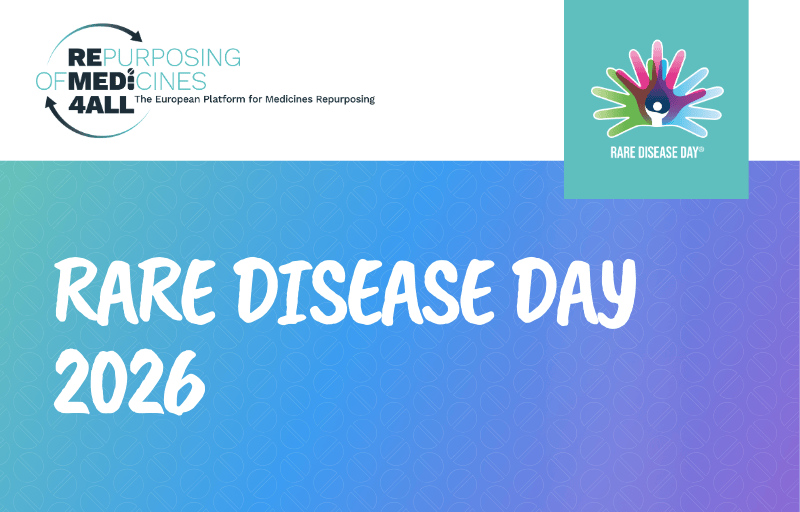
On 28 February, the rare disease community will come together to mark Rare Disease Day, a campaign to raise awareness for the 300 million people worldwide living with a rare disease, along with their families and carers. The campaign strives for equity in social opportunities, healthcare, and access to diagnosis and therapies for people living with a rare disease.
REMEDi4ALL is marking Rare Disease Day 2026 by sharing stories of drugs that have been repurposed to treat rare and ultra-rare diseases. Drug repurposing, finding new therapeutic uses for existing medicines, can be faster, safer, and more affordable than traditional drug development. This is especially relevant to rare diseases, where there is often little commercial interest in the development of new medicines for small patient groups.
Every Friday in February, REMEDi4ALL has shared a unique case of drug repurposing for rare diseases to highlight the importance of collaboration between the drug repurposing and rare disease communities and demonstrate the true potential of drug repurposing. Read more on the three cases REMEDi4ALL has highlighted below.
Repurposing Nitroxoline to treat Balamuthi Amoebic Encephalitis (BAE)
Balamuthia mandrillaris is an amoeba that can cause Balamuthia ameobic encephalitis (BAE), a serious brain infection. Although rare, BAE can be fatal, and, as infection progresses, symptoms can include confusion, seizures, difficulty walking and communicating.
Natasha Spottiswoode, an infectious disease physician-scientist with a focus on developing treatments for uncommon infections, was called to treat a patient with BAE. Natasha identified Nitroxoline through a drug repurposing screen assessing the effect of over 2000 compounds on lab grown cultures of Balamuthia Mandrillaris.
With evidence that Nitroxoline was effective against Balamuthi Mandrillaris outside of the body, Natasha contacted the FDA to request a single-patient Investigational New Drug (IND) application.
Treatment of BAE with Nitroxoline was a success, resulting from a collaboration between Natasha, the authors of the original research, the Centers for Disease Control and Prevention (CDC), and the company that produced the drug. As a result of this multistakeholder collaboration, Nitroxoline is now available for treatment of free-living amoeba through the CDC’s expanded access IND.
Read the full story here.
Repurposing Guanabenz to treat Vanishing White Matter (VWM)
Vanishing White Matter is a rare neurodegenerative condition that affects the white matter of the brain. In VWM, white matter gradually disappears, making it increasingly difficult for the brain to transmit signals throughout the body.
Guanabenz is an old and well-known drug that has been used for decades to treat high blood pressure. Given Guanabenz’s mechanism of action, scientists believed it may be helpful in treating VWM. Results from studies in laboratory mice show that long-term treatment with high doses of Guanabenz has a beneficial effect on the disease in mice with VWM.
A clinical trial is ongoing that aims to determine whether Guanabenz can slow progression, stabilise symptoms, or improve white matter in VWM. Early results from the clinical trial are promising and efforts to gain formal approval are underway. Dr Marjo van der Knaap (Amsterdam UMC) and Vincent van der Wel (Orfenix) are leading efforts to repurpose it through GuanaRep B.V., a patient-centric company supporting the project.
Read the full story here.
Repurposing Nitisinone to treat Alkaptonuria (AKU)
Alkaptonuria (AKU) is a rare genetic disease that causes a compound called homogentisic acid (HGA) to build up in tissues, bones and cartilage. This causes joint and heart problems, often needing surgery. Most people need several joint replacements over their lifetime, in addition to surgery for heart problems.
Nitisinone was already used to treat a condition called Tyrosinemia type 1 (HT1). Both HT1 and AKU are caused by gene mutations which affect the breakdown of a compound called tyrosine, and the subsequent build up of HGA.
Because of the similar disease mechanism, researchers hypothesised that Nitisinone could be repurposed for AKU. The AKU Society and its director, Nick Sireau, were instrumental in forming the DevelopAKUre consortium.
The consortium ran clinical trials of Nitisinone across Europe involving over 100 patients. The successful trials and unwavering determination of the patient group and consortium led to Nitisinone being approved for use in AKU in the UK and EU.
Read the full story here.
REMEDi4All drives patient-centric drug repurposing in rare diseases and beyond.
The REMEDi4ALL consortium is building a vibrant European research and innovation platform that facilitates fast and cost-effective patient-centric development and delivery of repurposed drugs.
Interested in learning more about drug repurposing in rare diseases and beyond? Don’t miss iDR26: the International Drug Repurposing Conference in Brussels, 12–13 May 2026.